California Permit Test Study Plan: A 7-Session Handbook Guide
Updated November 4, 2026 · 7 minute read
A California permit test study plan works best when it turns the current driver handbook into small, testable study sessions. Read one topic, recall it without looking, answer a few matching practice questions, and return to the handbook whenever you miss or guess. The plan below is flexible; it does not promise a pass or replace California DMV instructions.
Quick answer
Start with the current California Driver Handbook. Break it into topics, study one topic at a time, and keep a short error log with the handbook heading for every missed or uncertain answer. Mix signs, rules, and driving situations only after you understand them separately.
The seven sessions below are a study sequence, not a DMV rule or required calendar. For current eligibility, test format, appointments, or documents, use the California Driver Handbook and the DMV's instruction-permit information.
Set up your California permit test study plan
Before you study, open the current handbook from the California DMV and confirm that you are reading material for the credential and applicant path you need. Do not build a schedule around an old screenshot, an answer key, or a third-party page's test-length claim. The official handbook and DMV instructions take priority if a practice explanation differs.
Choose small blocks
Plan one topic per session instead of trying to memorize the entire manual at once. A short, focused block is easier to repeat and review.
Keep an error log
For each miss or guess, write the topic, the handbook heading to revisit, and the reason you chose your answer. Leave out personal information.
Separate facts from practice
The handbook explains the state's rules. An independent quiz is a study aid that helps you check recall; it is not an official test or source of current application requirements.
A seven-session California permit test study plan
Use the sessions in order, but move at the pace that lets you explain what you learned. If a session exposes a gap, repeat that topic before adding more material. The sequence is practical guidance, not an official California DMV curriculum.
Session 1: Map the handbook
Scan the table of contents and make a list of the chapters that apply to the knowledge test. Group them into a few buckets, such as signs and signals, road rules, safe driving decisions, and sharing the road. Mark anything that appears unfamiliar. This map helps you see what you have covered without guessing what the DMV will ask.
Session 2: Learn signs and signals
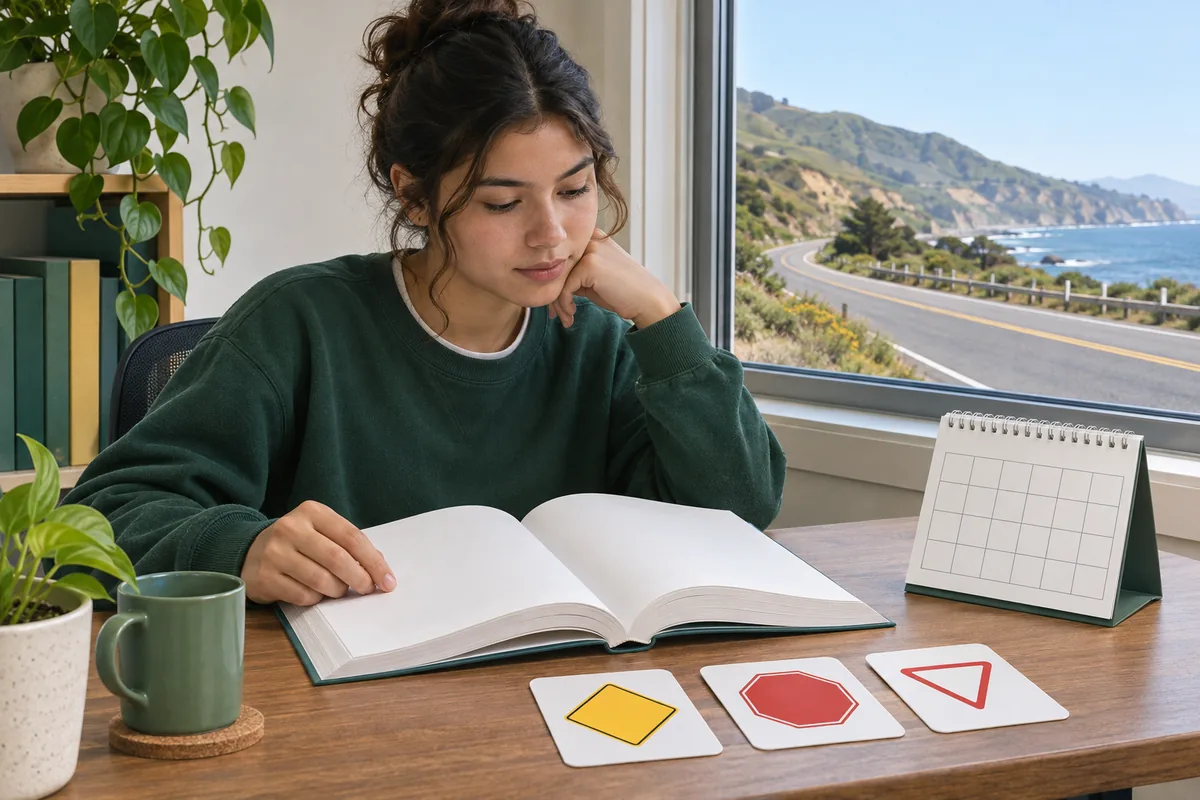
Study sign shapes, colors, symbols, traffic signals, and pavement markings from the handbook. Cover the explanation and describe what a sign communicates before checking it. Add confusing items to a small review list, then revisit only that list later. This is more useful than scanning the same cards repeatedly while recognizing the picture but not recalling its meaning.
Session 3: Work through intersections and right-of-way
Read the handbook's explanations for intersections, turns, yielding, and traffic controls. For each situation, describe what you should notice first and which road user or control changes your decision. Use the handbook wording when a detail is unclear. Do not rely on a simplified quiz answer to settle a rule that could depend on the road situation.
Session 4: Review lane use and vehicle control
Study lane position, speed choices, following space, parking, backing, and changes in road conditions. Make a two-column note: the driving situation on one side and the safe response described by the handbook on the other. Keep the note brief enough to cover from memory. The purpose is to connect a rule to a situation, not to create another long document to memorize.
Session 5: Cover hazards and sharing the road
Review sections about pedestrians, cyclists, motorcycles, large vehicles, distraction, impairment, fatigue, and what to do when a hazard appears. Focus on the decision behind each rule: what risk it controls, what you need to notice, and what response keeps more options open. For any legal limit or penalty, read the current handbook directly rather than copying a number from an old quiz or article.
Session 6: Practice by topic and repair gaps
Try a short set of questions for the sections you studied. Mark each answer as known, uncertain, or guessed, even when a guess is correct. Afterward, return to the matching handbook heading for every uncertain or missed item. The site's California practice quiz can provide an independent self-check, but its question count and score are not a statement of the official DMV exam format.
Session 7: Mix topics and check logistics
Complete a mixed review, explain your reasoning without looking at the answer, and revisit the three topics that still take the most effort. Then use the California DMV pages to confirm the current testing path, appointment details, applicant requirements, and what you need to bring. Keep this administrative check separate from your study score: a high practice result does not confirm that an application is complete.

Use a review loop instead of memorizing answer letters
Each practice question should point you back to a rule or idea. After a miss, do not copy the correct letter and move on. Write the topic in plain language, find the matching handbook section, and explain the rule without looking. Then try a new example or another question later. Returning after a gap checks whether you learned the idea rather than memorized the first wording.
- Classify the miss. Was it a sign, a right-of-way decision, a road marking, or a misunderstood word in the question?
- Find the source. Use the handbook heading or official page that explains the topic.
- Restate the rule. Explain what you would do and why, without copying the answer text.
- Check it later. Revisit the topic in a mixed set after studying something else.
If you cannot find support for a practice explanation in the current California handbook, do not treat the practice page as the authority. Set that question aside and verify the rule with the California DMV.
How to use a California permit practice test accurately
A practice test is most useful as a diagnostic. It can reveal that you confuse two signs, overlook a condition in a scenario, or answer too quickly. Use that signal to choose the next handbook section. It cannot tell you exactly which questions the DMV will serve, verify your eligibility, book an appointment, or guarantee a passing result.
| Practice result | Study response | What to verify |
|---|---|---|
| Missed a road sign | Review its shape, symbol, and meaning in the handbook; test yourself again later. | Use current handbook material, not a saved answer image. |
| Guessed correctly | Mark it uncertain and explain the rule before counting it as ready. | Check the condition that changes the safest response. |
| Missed a scenario | Write down what you noticed too late and what you should check first next time. | Return to the related handbook section. |
| Practice score improved | Mix topics and repeat after a break; look for steady understanding. | Confirm official test and application details separately. |
The local California quiz uses a 46-question practice format. That number belongs to the independent quiz on this site; it should not be presented as the DMV's official question count. For the real test's current version and instructions, check California DMV information directly.
Common study mistakes to avoid
- Studying only from question banks. A quiz may omit a topic or simplify a rule. Keep the handbook as your reference and use questions to test recall.
- Counting guesses as knowledge. A lucky answer does not show you can recognize the same idea in a different situation. Record uncertainty as a review item.
- Using old screenshots as current law. Saved notes can become stale. Reopen official DMV material when a number, requirement, or test process matters.
- Repeating only familiar questions. Familiar wording can make a score rise without improving understanding. Use mixed topics and explain your choices.
- Confusing a practice score with eligibility. Study readiness and application readiness are separate. Verify the current DMV requirements for your age and applicant category.
Verify the California DMV details before test day
Rules and testing instructions can change, and different applicant categories can follow different steps. Before you travel or begin an online process, check the current California DMV instructions for your own application. Confirm the testing method, appointment or check-in details, accepted documents, fees, and any required preparation through official pages rather than relying on a generic checklist.
Use these official references as your starting point:
- California Driver Handbook for current study material.
- California DMV instruction permits for application-path information.
- What to bring to a DMV permit test for a general document-planning checklist; confirm California specifics with DMV.
- How to prepare for a DMV permit test appointment for a general appointment workflow.
This article offers a study method, not legal advice. The California DMV controls current eligibility, exam format, fees, and appointment requirements.
California permit test study plan FAQ
How long should I study for the California permit test?
Use enough short sessions to explain the handbook topics and review uncertain answers without guessing. Seven sessions are a flexible order, not an official DMV schedule or a guarantee.
What is the best way to study for a California permit test?
Read the current California Driver Handbook, recall the idea without looking, practice that topic, and return to the matching handbook section whenever you miss or guess an answer.
How many questions are on the California permit test?
Check current California DMV instructions for the applicant version that applies to you. Independent practice quizzes may use a different number and format.
Is an online California permit practice test the same as the DMV exam?
No. An independent practice test can help you review, but it is not an official exam, does not issue a permit, and cannot promise that the real test will use the same questions.
Should teenagers and adults use different study plans?
The handbook review method can help either group, but education, application, identity, and testing rules may depend on age and applicant category. Verify your route with California DMV.
What should I do if I keep missing road-sign questions?
Group the missed signs by the message they communicate, revisit the related handbook material, and describe each sign in your own words before trying a fresh set.
Does this site's 46-question practice page show the official DMV test length?
No. It is an independent practice format. Use current DMV instructions for the official test length and version that apply to your application.
Continue your California permit test preparation
Use the California permit practice quiz to find topics for another review, or compare how requirements vary in the permit test by state guide. Keep the official California Driver Handbook open whenever a practice explanation needs confirmation.